Shelter: the bulldozer, not the key
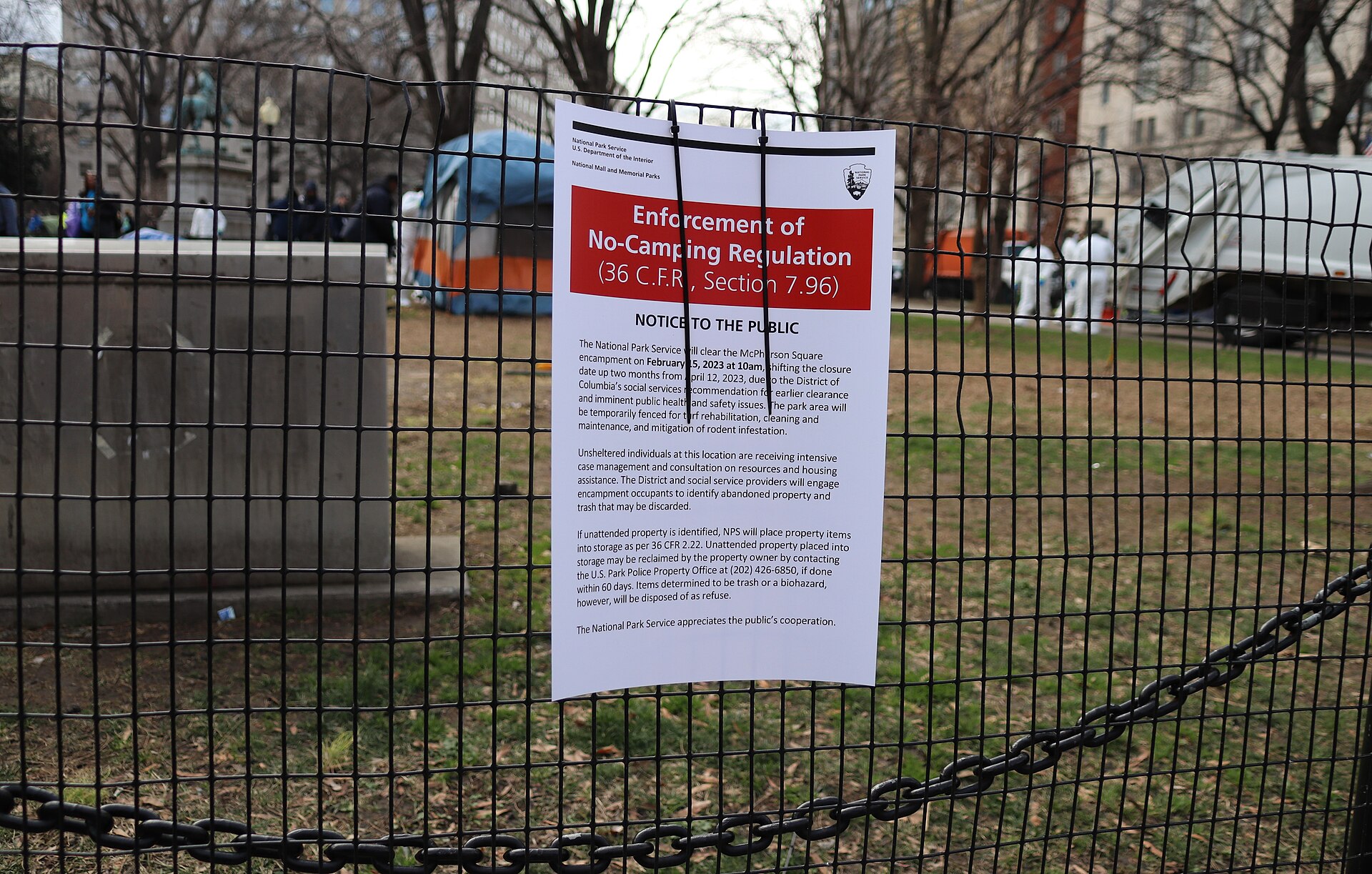
On the afternoon of January 10, 2024, in twenty-four degrees of frost, Edmonton tore down the last of eight encampments it had decided were too dangerous to let stand. City workers in white hazmat suits loaded people's tents into a truck. Police arrested a man, two women, and a reporter covering the scene. Arlen Plashka, from Saddle Lake First Nation, watched his home go into the truck and said the only thing there was to say: "I feel violated… I am a human being. These are our homes" (tents torn down). He did not feel safe in a shelter, and he did not know where he would sleep. This is the compassionate city's answer to homelessness, rendered in the plainest possible terms. Not a key. A truck, a fence, and a fine.
The lawsuit the city fought and won
Behind that January morning is a lawsuit worth understanding, because it shows how a progressive council treats the poor when the poor go to court. In August 2023, the Coalition for Justice and Human Rights sued the city over its encampment policy, calling the winter evictions a violation of Charter and human rights (case summary). On December 14, 2023, the Coalition filed an emergency injunction application; the next day the court imposed a temporary injunction running to the following Monday. On December 18, rather than fight it out, the parties negotiated a temporary court order. Its terms bound the City, before it displaced anyone, to confirm that adequate shelter space was actually available, to account for the dangers of the cold, and to give prior notice to residents and to the agencies supporting them (litigation timeline). Then, between December 29, 2023 and January 10, 2024, with that order in force and its conditions binding, the city cleared all eight encampments. On January 16, 2024, before anyone could test whether those conditions had been met, Justice Jonathan Martin ruled that the Coalition lacked public-interest standing (2024 ABKB 26): it did not have the track record to speak for unhoused people. He struck the action on that procedural point, never reaching whether the sweeps were unconstitutional (emergency declared, standing denied). The order's protections were never tested on the merits. Edmonton Police had already secured intervenor status; the chief remained "confident in the EPS approach." Then the city that had just escaped a Charter ruling asked the court to make the losers pay. It sought $25,000 in costs against the Coalition and was awarded $11,500 (2024 ABKB 148). Read that back slowly. A group that sued to stop people freezing in tents was ordered to write the city a cheque. The city agreed to conditions meant to protect the unhoused, cleared the camps while bound by them, and watched the case die on a standing technicality before any judge could ask whether it had kept its word.
The machine ran faster once the leash came off
The most telling fact is what happened the day after the case died. On January 17, city administration stood up an Emergency Operations Centre, the apparatus normally reserved for wildfires and playoff crowds, and pointed it at the poor (49 encampments, EOC). In two weeks it razed 49 encampments, 211 structures, 175 people's homes. The Coalition's lawyer named the mechanism exactly: "they're doing this because that lawsuit no longer exists. They feel emboldened." Over the following stretch the city swept 179 encampments in 23 days, nearly eight a day (mass displacement). Across all of 2024 it dismantled roughly 3,819 encampments, about double the year before (homelessness up 47%). And the "navigation" the city offered instead? Of 231 people who reached the new Navigation Centre, only 65 got a housing referral, fewer than a quarter. And the city manager admitted he had "no idea" whether anyone referred actually ended up housed, calling it a gap in the data. The quickest realistic path into a home, his own director said, was "59 days at best." Fifty-nine days is no answer at all to a person sleeping outside tonight; it is the tempo of a system built to move people along rather than house them.
The fine, the fence, and the bill for existing
The eviction is only the first instrument. In February 2024 council brought in the Public Spaces Bylaw 20700, a fine schedule aimed squarely at people with nowhere to go: $250 to pitch a tent, another $250 to occupy it. Five hundred dollars for the crime of sleeping. Plus $250 for lingering at a transit stop and a ticket for sleeping in your car in a park (bylaw 20700 fines). A defence lawyer put the logic bluntly: "we just end up incarcerating the homeless." Then came the fence. In the first nine months of 2024 the city spent $225,000 fencing off cleared sites so people could not return, against $3,400 in all of 2023 ($225k in fencing). That is a sixty-six-fold jump in money spent specifically to keep the poor out of the ground they had been sleeping on. As one advocate said, the city "spent all of the money putting up fences just so that people could be stopped from putting up shelter." Chain-link is a policy statement. Edmonton wrote it in nine months and a quarter of a million dollars. None of this touched the actual shortage. In January 2024 there were about 3,051 people homeless in Edmonton, 694 of them completely unsheltered, against roughly 1,550 to 1,801 shelter spaces. That is a gap of well over a thousand beds that do not exist (shelter numbers). By September the count hit a record 4,697, up 47% in a single year and more than triple the pre-pandemic figure, with 1,162 people entirely without shelter (surge to 4,697). And the colonial arithmetic underneath it all: more than half of the counted homeless are Indigenous, in a region that is about 6% Indigenous. That figure measures dispossession, continuous from the treaty to the truck.
Honest complication: empty beds and provincial jurisdiction
Two facts complicate a straight story, and both survive the argument. First, the shelters were not full. Overall occupancy ran about 75–80% even as the sweeps continued (shelters aren't full). The province weaponized that emptiness to deny a crisis, but the emptiness is downstream of bad shelter design: people stayed away because congregate shelters felt unsafe, sat far from where they lived, or turned away partners, pets, and possessions. Available beds are not usable beds. Second, shelter operations, housing, and addictions care are genuinely provincial jurisdiction, and the sweeps were formally province- and police-led. The city's honest defence is limited authority. But the city supplied the crews, stood up the Emergency Operations Centre, spent the $225,000 on fence, and wrote Bylaw 20700. Limited authority is not zero authority, and the city used the authority it had to fence and fine rather than to shelter.
The bodily toll of the cold
The bulldozer leaves a medical signature, and you can read it on unhoused bodies in lost fingers and lost feet. Edmonton is what the Canadian Frostbite Care Network calls Canada's frostbite capital, and the amputations tell you why the title is not rhetorical. In the Edmonton health zone, surgeons performed 91 frostbite amputations in fiscal 2021–22, 71 the next year, then 110 in 2023–24, a record, and 113 in 2024–25, more than five times the level of fiscal 2019 (new high, decreased Calgary; record amputations 2025). These are the tissues that die when a person cannot get warm, cut away so the rot does not spread. And they are not distributed evenly across a city. The homeless share of frostbite-amputation visits climbed from 39% to 58% in a single year and stayed above half. That is a population estimated at about 0.3% of Edmonton absorbing a clear majority of the amputations (most amputations homeless, 58%). When amputations jumped 55% in 2023–24, the rise among unhoused patients was 87%. Since 2021, 188 frostbite amputations have been carried out on unhoused Edmontonians. Dr. Sandy Dong, an emergency physician of twenty years, said the only surprise in the numbers was that the homeless share "isn't higher." Set that curve beside the calendar and it points straight back at the truck. The city runs its winter emergency response on the harshest benchmark in Canada: it activates extra shelter shuttles and overnight spaces only when the forecast drops below −20°C for three straight days. The risk of frostbite begins the moment the temperature crosses 0°C. The predictable result: 35% of severe frostbite cases in two studied winters happened on days the city had not declared cold enough to act. The people who staffed the ERs said out loud what the policy would not. Dr. Scott MacLean of the Royal Alexandra: "We lost a lot of shelter space last year, especially during the winter in the daytime… So many of our patients were coming in saying, 'Yeah, I was in shelter last night,' and they left in the morning and then they got frostbite." Take away the daytime warmth, and the daylight hours become the wound. That is not an abstract policy tension; it runs through the exact sweeps described above. The lawyer whose freedom-of-information request pried these numbers loose, Coalition counsel Chris Wiebe, saw "a direct connection between the encampment removals and the spike in frostbite amputations." And the police did not entirely deny it. EPS conceded the rise "may be due to greater intervention by EPS encampment response teams, who regularly found people needing medical assistance for exposure, hypothermia and frostbite." Remember what the December 2023 court order required: before displacing anyone, the city was bound to weigh the dangers of the cold. It cleared all eight camps anyway, the last of them at −24°C. The very morning this page opens on. The order asked the city to consider the cold. The city considered it and sent in the trucks. The deadliest edge of this is harder to count cleanly, so we count it carefully. Homeless deaths in Edmonton rose from 37 in 2019 to 302 in 2023. That is Alberta Justice's own data, independently corroborated by Boyle Street Community Services at 301 of those 302 (deaths up 8×). That is a real and staggering number, an eightfold rise in people dying without a home. But it is all homeless deaths, the majority of them drug poisoning, and the province withholds the cause breakdown, so exposure and hypothermia are a documented but unquantified share of it. We will not tell you 302 people froze, because we do not know that and neither does anyone else. The cold-specific harm we can count honestly is the amputations. Those alone are indictment enough.
Honest complication: correlation, better detection, and the Calgary problem
The link between the sweeps and the amputations is a correlation supported by clinical testimony, not a proven cause, and there are three honest edges. First, the two amputation counts do not stack: the fiscal Edmonton-zone series (91/71/110/113) and a separate calendar "Edmonton area" count (81 in 2023, 120 in 2024) use different definitions and geography, so we lean on the fiscal series as the spine and treat the calendar figures as corroboration, not addition. Second, part of the rise is genuinely better detection. These datasets came out of FOIs, and awareness and coding improved. What survives that caveat is the steep shape of the curve and the majority-unhoused share, which better paperwork does not manufacture. Third, Calgary's lower and falling numbers are over-determined: Calgary uses the drug iloprost aggressively while Edmonton rarely did, so the gap between the cities reflects treatment as well as eviction policy. That is why the argument rests on Edmonton's own curve and its own doctors, not on a tidy city-versus-city scoreboard. The claim is priority and correlation: a city that swept in the cold while the cold-injury numbers climbed. It is not a mechanical proof that each eviction caused each amputation.
Where the two men stood
Both Janz and Knack backed the January 2024 homelessness-emergency declaration; the four councillors who voted against it were named, and neither of them was among the four (emergency declared). From there the records split, exactly as they split on police. On the shelter-regulation bylaws that added restricting and sunset clauses (20657, 20842, 21193), Knack voted yes and Janz voted no, every time (shelter votes). Janz said the true thing out loud: "If people don't want to go to the shelter, you can't force them… They'll leave and set up camp somewhere else," and "I'm not optimistic that a majority enforcement approach is going to address the root causes" (49 encampments). Knack reached instead for the escape hatch, framing shelter and housing as "primarily provincial jurisdiction". The city presses and partners, the province is to blame (Knack, Edmonton Votes '25). Give Janz his due: on the shelter votes he was on the right side, and he lost. But being right in the transcript is not the same as stopping the truck. The sweeps were administrative; there was no up-or-down vote to block, and no councillor called the bluff by demanding one. When the lawsuit was live and a word from a sympathetic councillor might have mattered, Janz went quiet. It was a silence a friendly left outlet called out directly, noting he "remained silent despite typically advocating for unhoused people" (the silence). That is the shape of the whole project. The dissent is real, the skepticism is real, and the fence still went up. Skepticism that never halts a sweep amounts to the polite management of the poor, narrated by someone who feels bad about it. The money that bought the fence is the same money guaranteed to the police formula and denied to the frontline that keeps people alive.