The police formula: the one line that never fights for its money
Every autumn Edmonton holds a budget fight, and every autumn it is the same fight. The library makes its case. Transit makes its case. The outreach workers who run warming buses and hand out sleeping bags make their case, hat in hand, and lose a little more ground to inflation than they gained. Then there is one line on that budget that skips the room entirely, because a previous council wired it to a machine. Police funding in this city no longer has to win an argument. It grows on a formula, on autopilot, whether or not anyone on council thinks it should. And the people praised as Edmonton's progressives built the machine. They keep it running.
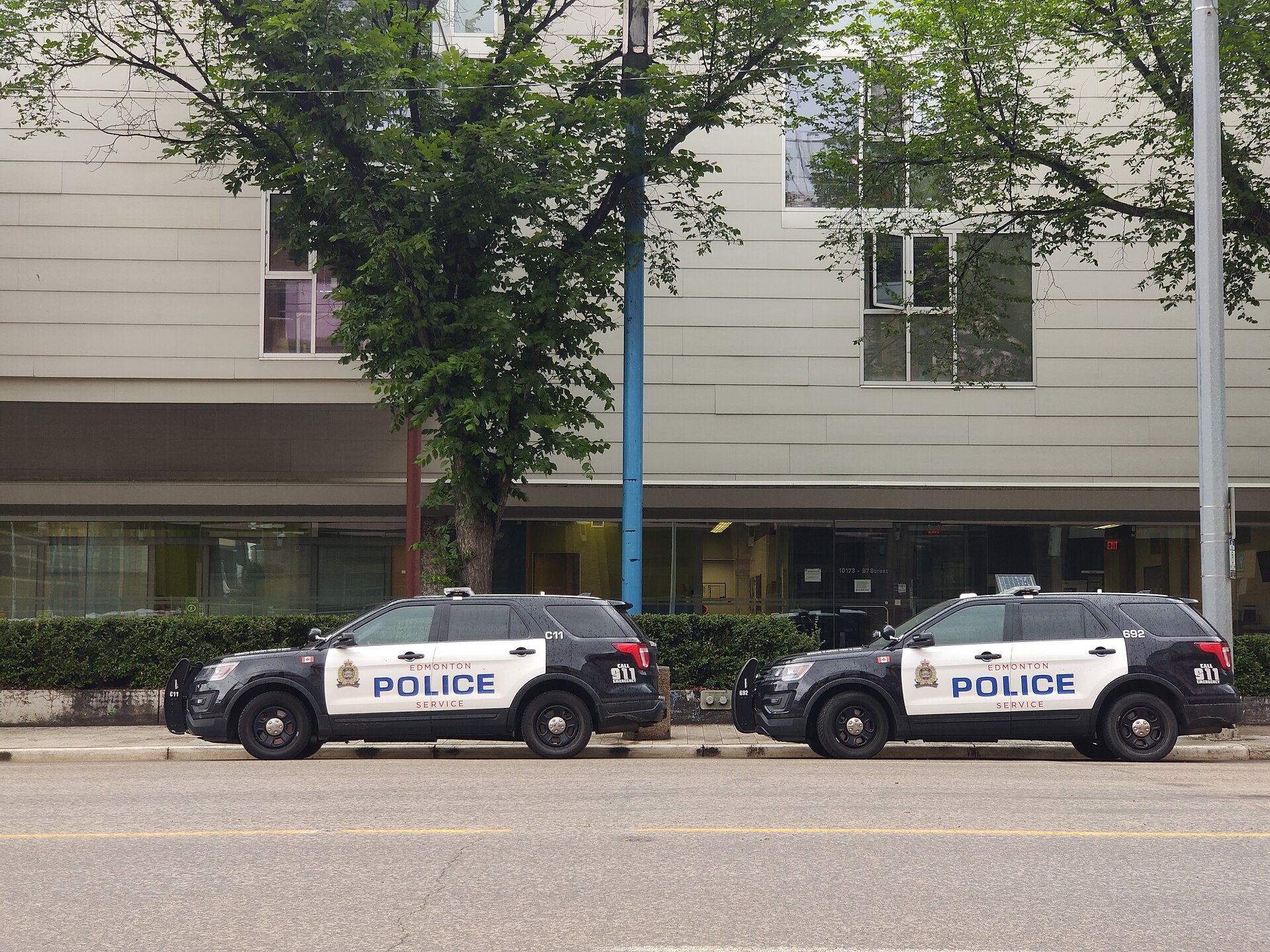
Follow the money and the size of the thing announces itself. Councillor Michael Janz, using the city's own numbers, puts police funding at $378 million in 2019 and $475 million projected for 2026. That is an extra $97 million, roughly 26%, in seven years (Janz on police funding). It is the biggest single item in the municipal budget and on your property-tax bill, about 15.4% of what the city spends. In Janz's blunt phrasing, "no one spends more on policing than Edmonton." And over the 2023–2026 window he sets the growth rates side by side: EPS up 12.4%, the public library up 4%. That gap is not weather. It is architecture.
How the machine works
The architecture has a name and a paper trail. The city adopted a multi-year police funding formula. It started as policy C604, refined into C604A in October 2022, then a revised C604B on August 23, 2023. The formula fixes each year's police budget as the previous year's budget, plus a formula adjustment tied to population growth and inflation, plus negotiated salary settlements (the formula vote). A cap keeps the police line under 30% of the city's net operating spending, which sounds like a leash until you notice what it really is: a guarantee that a department already at 15% has room to nearly double before the ceiling even bites. Once the formula was adopted, the increase happens by itself every year. Council never has to vote a fresh raise into being. As the formula's champions cheerfully admitted, the point was to "get away from having these rhetorical conversations all the time". Which is to say: get away from having the vote at all. That is the trick worth naming plainly. Democracy is the annual argument about what we owe each other and what it costs. A funding formula is a decision to stop having that argument for one favoured department, and to keep having it, brutally, for every other. The warming bus fights for its life each November. The cruiser does not.
The roll-call
The record is not ambiguous, because Edmonton publishes its votes. Reconstructed from the city's open-data voting datasets, here is the through-line. Who moved the money. Who backed it. Who lost.
| Date | Motion (abbrev.) | Janz | Knack | Outcome |
|---|---|---|---|---|
| 2018-11-28 | EPS budget cut −$2.742M/yr ongoing | n/a | Yes | Carried 10–3 |
| 2021-11-30 | Janz moves: cut 2022 EPS levy $11.9M | Yes (mover) | No | Defeated 5–8 |
| 2022-06-07 | Raise EPS floor to $407M/yr | No | Yes | Carried 12–1 |
| 2022-08-15 | Healthy Streets Operations Centre +$5.8M EPS | No | Yes | Carried |
| 2022-10-07 | Approve EPS funding formula C604A | No | Yes | Carried 9–4 |
| 2023-08-22 | Approve revised formula C604B (moved by Knack) | No | Yes | Carried 9–4 |
| 2024-04-23 | EPS operating reserve payback | No | Yes | Carried |
Read down the Knack column and you are reading the biography of a costume. One that took a full decade to sew on. In his first term he voted the other way: in November 2014 the freshman Knack voted against a $5.2M police growth package, against a $1.6M transit-policing expansion and against two helicopter purchases, and in 2015 he personally moved a million dollars into a 24/7 non-police crisis-response program (first-term votes). Back in 2018, on the old council, he voted to cut the police budget. Nearly $2.75 million, ongoing. By 2023 he was not merely voting for the escalator, he was moving it himself: C604B, the revised formula that locks the growth in, carried 9–4 on Knack's own motion. The man Edmonton has now made mayor built the police machine's final gear and pulled the lever himself. Asked about it a year later, he did not hedge: "Originally, I had a concern with a standalone police funding formula… I did support that funding formula," he said, because "there does need to be some stability" (Knack, Edmonton Votes '25 interview). Stability for the cruiser. Instability, by construction, for everything else.
What the guaranteed cheque denies everyone else
This is where the police beat stops being about police and becomes about a whole city. A municipal budget is close to zero-sum: the money is finite, and a line that is guaranteed to rise is a line that squeezes every line without a guarantee. Set the formula-locked 12.4% growth of EPS beside the 4% the library scraped over the same years. That library's provincial operating grant has been frozen since 2015, its buying power quietly eaten by inflation until provincial money that once covered half of operations now covers about a third (library funding freeze). The blank cheque for policing is the cut to the library, the fare hike on the bus, the fence around the park. You do not have to believe the city set out to starve its frontline to see that the machine it built does exactly that, every year, automatically. The fuller anatomy of the EPS budget itself, where the money goes once it is guaranteed, is the subject of a sibling investigation at ../eps-black-box-budget/. The point here is narrower and harder to dodge: the same council that called itself progressive is the council that put policing on cruise control and made everyone else beg.
And the money is not even buying what the fear campaign says it buys. Janz, citing the criminologist Temitope Oriola, notes that the large majority of police calls, a combined 89.1%, are matters like shoplifting and vandalism, "not necessarily matters of life and death." His own conclusion is the one the formula was designed to drown out: "Even if we tripled the number of police officers, it wouldn't address… poverty, addiction, and social disorder." The escalator does not protect you from the crisis. It processes the crisis, expensively, after the city has declined to prevent it. That theme runs straight through the criminalization of homelessness and the starving of the frontline.
The dissenter who signs the cheque
He is the most consistent police-restraint vote on council, and he loses. He moved to cut the 2022 EPS levy by $11.9 million and went down 5–8. He voted no on the floor increase and lost 12–1. He voted no on both versions of the formula and lost 9–4, twice. Read honestly, his column is a record of principled defeat. But defeat is only half the exhibit. The other half is what a losing dissenter does after he loses. What Janz did, on November 30, 2022, was vote yes on the 2023 operating budget, the very budget that carried the police money he had just failed to cut, and then own the tax increase inside it (budget and shelter votes). He describes his theory of change as "moving the Overton window." That is the whole tragedy of the electoral left in one phrase. You can be sincere, well-briefed, and correct about the numbers, and still, when the gavel falls, sign your name to the machine you spent all year opposing. Dissent that always converts back into a yes never actually slows the car. It is only the sound a brake makes while the machine keeps moving.
The body count
Follow the money far enough and you reach a body. The formula does not just move dollars from the warming bus to the cruiser; it funds a machine whose core function is force, and force in Edmonton kills at a rate that has no peer in the country. In 2022, EPS officers had four fatal shootings by late April alone. That was a twenty-two-year high, and roughly thirty percent of every fatal police shooting in all of Canada that year, in a single mid-sized prairie city, while Toronto, Montreal, Vancouver, Ottawa and Winnipeg each recorded zero (most fatal in Canada, 2022). In 2024 the department was involved in nine officer-involved shootings, four of them fatal (EPS use of force, 2024). Widen the lens and the picture holds: thirty-nine people have died in encounters with Edmonton police since 2000. That is the second-highest count of any municipal force in Canada, behind only Toronto and ahead of Calgary's twenty-nine (2nd-most police deaths). Alberta's police-involved death rate jumped 166% between the 2000s and 2011–2022, the steepest rise of any major province, and the province leads the country per capita. The criminologist Temitope Oriola, who studies exactly this, does not soften it: "there's no denying that we do have an excessive use-of-force problem in Edmonton… Alberta leads the way nationally." Who is it that dies. Of twenty-three people killed in EPS encounters between 2000 and 2017, twenty-one, ninety-one percent, were in a mental-health or addictions crisis (mental-health deaths). Read that number beside the formula and the whole design gives itself away. The people the machine kills are overwhelmingly the same people a funded, non-police crisis response exists to reach: the person mid-breakdown, the person in withdrawal, the person a mobile mental-health team is trained to talk down and an armed officer is trained to command. The council guaranteed the budget of the response that shoots them and made the response that could have reached them beg for its money every November. Black and Indigenous Edmontonians turn up over-represented among the dead; the flashpoint of 2024 was Mathios Arkangelo, a Black man shot on June 29, whose family sued four officers and the chief. And the accountability that is supposed to answer for those bodies is a revolving door that opens outward. Alberta's police watchdog, ASIRT, clears EPS fatal shootings as a matter of routine. The house phrase is "proportionate, necessary and reasonable". A man shot twelve times in 2024 was cleared (ASIRT clears two officers). Across the entire tenure this project examines, a single EPS shooting produced a criminal charge: Sergeant Neil Thompson, aggravated assault, over a non-fatal 2024 shooting (the rare charge). One charge. That is not oversight; it is absolution with paperwork. The department kills at a national-leading rate, investigates itself through a body that almost never charges, and draws its budget from a formula that never has to explain a single death to win next year's raise. The machine on cruise control is a machine that kills, and no line on the budget was ever conditioned on it killing less.
Honest complication: correlation and priority, not a trigger pulled by a budget
This section names a correlation and a set of priorities, not a causal chain. We do not claim the funding formula pulled a trigger, and there is no clean per-year shooting curve to chart. The honest anchors are 2022 (the record year), 2024 (nine shootings, four fatal), and the thirty-nine-since-2000 total. Anyone drawing a smooth line between them is inventing data. Three distinctions matter. The 221 "shootings" EPS reported in 2023 are citywide gun violence, not officer-involved shootings. Never conflate the two. The ASIRT charged-officer totals (4, 4, 7, 2, 7, 3, 2, 5, 1, 8, 10 across 2015–2025) are Alberta-wide, not EPS-only (ASIRT charged-officer stats). And the racial over-representation is qualitative in the sources, not a hard EPS percentage. The ninety-one-percent mental-health-and-addictions figure is the solid one. For fairness: EPS itself lost two officers to gun violence in March 2023 and cites rising violence to justify force; that is a real loss and a separate category from police killings of civilians. The argument here is not that the budget did the killing. It is that a city chose to guarantee, with no annual argument, the growth of the one institution whose record is this. And it chose to make everything that might have prevented these deaths fight for scraps.
Honest complication: we confirmed the votes, not the escalator rate
The formula is often described as roughly a 5%-a-year automatic increase. That specific rate cannot be derived from the roll-call votes on this page. It lives in the city's Financial and Corporate Services formula reports and is examined in the sibling EPS project, not proven by the adoption votes. What is confirmed here is the structure and the record: the formula was adopted (C604A in 2022, C604B in 2023, both 9–4), Knack moved the 2023 version, Janz voted against every police increase, and the dollar totals, $378M in 2019 to $475M in 2026 at about 15.4% of the budget, trace to Janz's own published figures and the sibling reconstruction (Janz on police funding). Treat the ~5% figure as belonging to the formula's own documents, not to these votes.
How the roll-call was built
The votes above were reconstructed from the City of Edmonton's open-data council voting records: the 2017–2021 term (dataset huhs-auh6) and the 2021–2025 term (dataset ekzq-b4qg), with Janz in the m_janz column and Knack in a_knack (recorded votes; voting datasets). Outcomes and mover names were confirmed against contemporaneous reporting on the August 2023 formula vote (the formula vote). Figures are CAD, source year noted.