Two faces, one dead end
Edmonton is handed two men as the proof that its council has a left. One of them wins and one of them loses, and the city tells itself that the split is the argument. As long as somebody on the inside is voting the right way, the conscience is covered. This page takes the split seriously, because the split is real and it deserves to be honoured exactly. But honouring it does not save the story. It sharpens it. Andrew Knack and Michael Janz are two different failures of the same dead end, and the difference between them is the difference between the man who serves the order and the man who cannot stop it.
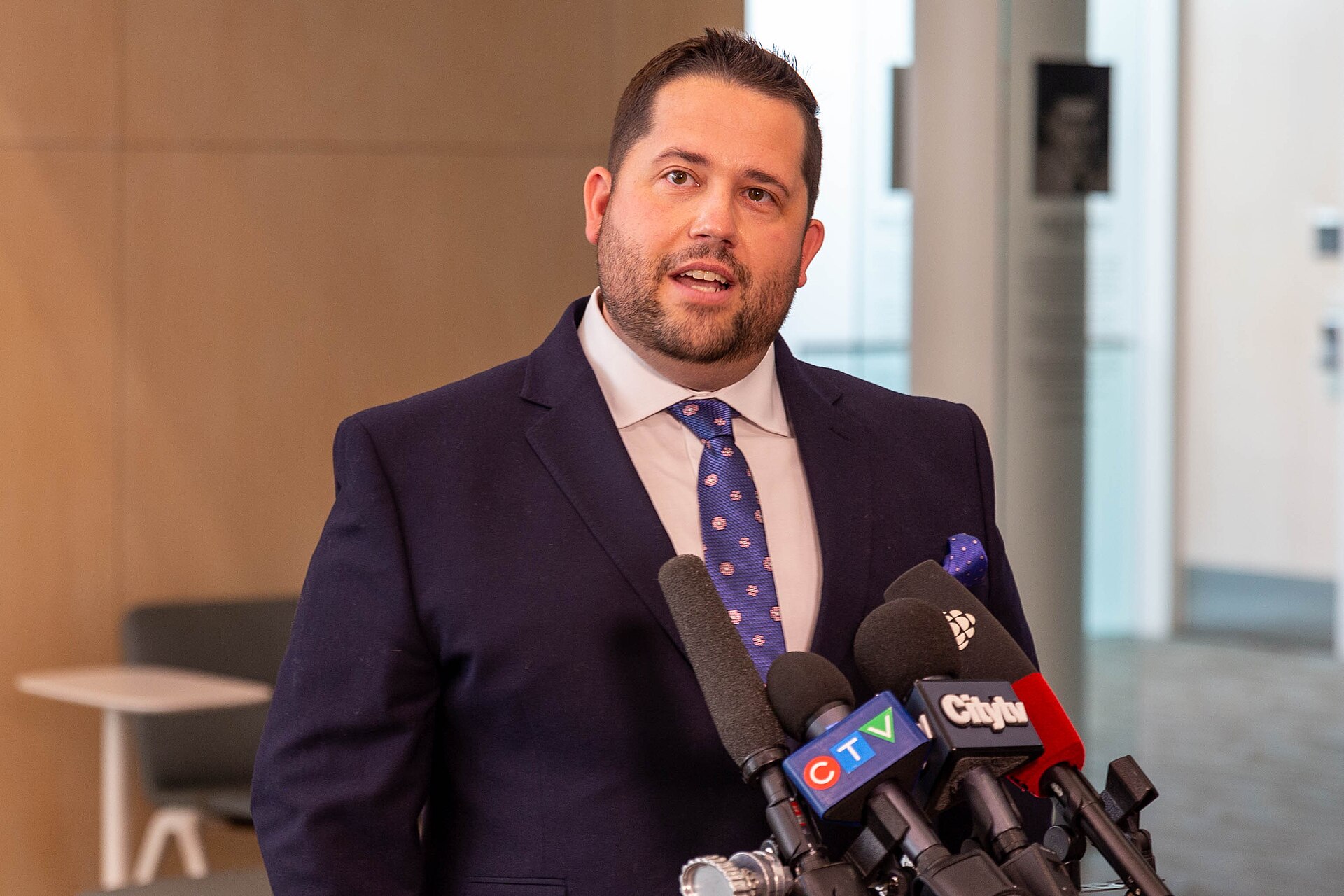
Knack: the manager who wins
Andrew Knack sat on council for twelve years, from 2013 to 2025, before Edmonton elected him mayor in October 2025 on about thirty-eight percent of the vote. Judge him on the decade, not the months in the chair. The mayoralty is the punchline, not the indictment. He tells the story of himself as a conversion: raised, in his own words, "very very right-wing," landing somewhere he now calls "centre-left." Never socialist, never anti-capitalist; the ceiling is self-declared. And the costume, it turns out, was put on rather than born. It took a full twelve years. In his very first term he was, if anything, a police-budget skeptic: on a single night in November 2014 the freshman Knack voted against a $5.2M police growth package, against a $1.6M transit-policing expansion, and against buying the force new helicopters, and he personally moved a million dollars into a 24/7 non-police crisis-response program instead (first-term votes). Back in November 2018 he voted for a police budget cut, trimming $2.742M a year on a 10–3 vote. By 2023 he was not merely voting for the police line. He was its architect. The register never changed. It was always cost-benefit, always "look at the money." Only the direction the ledger pointed.
The instrument is a funding formula, policy C604 through its revisions, that puts the Edmonton Police Service budget on an escalator: a guaranteed net operating requirement that grows year over year without an annual up-or-down vote. In August 2023 the revised formula, C604B, carried 9–4, on Knack's own motion. He moved it himself. This is the tell that matters more than any speech: when the moment came to write policing a blank cheque and lift it out of the yearly fight that every other service has to survive, the man the city would soon elect as its centre-left mayor picked up the pen. Not the most progressive person in the room. The most electable one. He served the order, and the order rewarded him with the mayor's office.
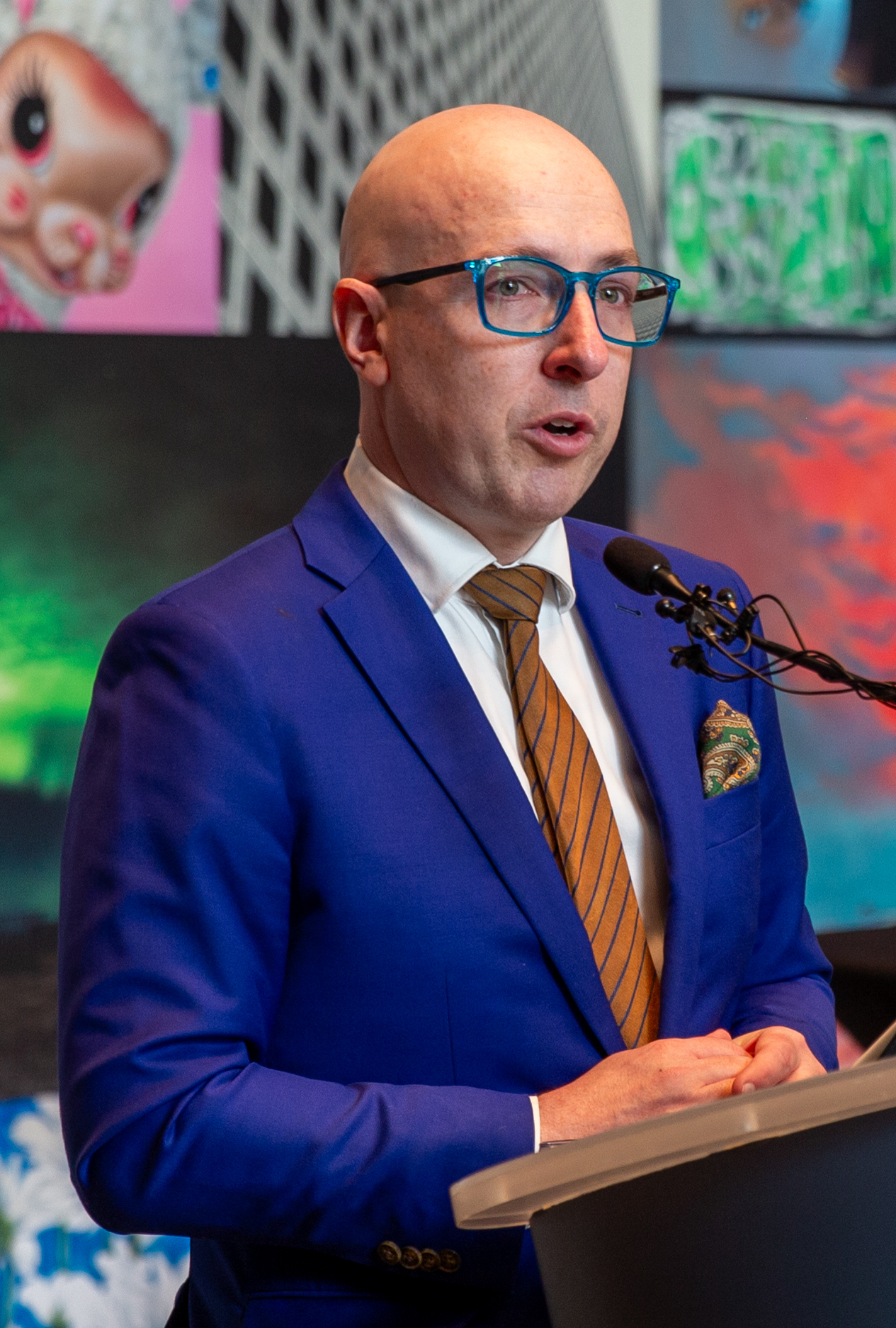
Janz: the dissenter who loses
Elected in October 2021 for Ward papastew, Michael Janz carries the most genuinely left-inflected vocabulary on council. He names "the capital class," he refuses developer money, he talks about resisting privatization and running public assets for public benefit. On police he is the most consistent restraint vote in the building. He moved to cut the 2022 EPS levy by nearly twelve million dollars and lost 5–8. He voted against raising the EPS floor to $407M and lost 12–1. He voted against the funding formula, both C604A and C604B, and lost 9–4 each time. On the specific question of the police escalator, the record is unambiguous: Janz was against it. We will never write that Janz supports the police, because on the votes he does not.
And then comes the hinge. Having lost every motion to cut the police, Janz voted yes on the final 2023 operating budget. That budget carried the very police money he had just failed to strip out, and he owned the tax increase inside it. His one redistributive idea, a mansion tax on the city's most valuable homes, he floated and then shelved under administration pushback, and told a sympathetic outlet he would not campaign on it. His stated theory of change is "moving the Overton window": nudge the conversation, year by year, and call the nudge a victory. That is not a slander. It is his own account of what he is for. Dissent, defeat, signature. The two-step is the exhibit.
The roll-call
Here is the record, pulled straight from the city's own voting data. Read down the two columns and the pattern is plain: Janz loses, Knack wins, and the police line grows either way.
| Date | Motion (abbrev.) | Janz | Knack | Outcome |
|---|---|---|---|---|
| 2021-11-30 | Janz moves: cut 2022 EPS levy $11,943,000 | Yes (mover) | No | Defeated 5–8 |
| 2022-06-07 | Amend EPS floor $385M → $407,000,000/yr | No | Yes | Carried 12–1 |
| 2022-06-07 | EPS funding $407,000,000/yr from 2023 | No | Yes | Carried 12–1 |
| 2022-08-15 | Healthy Streets Operations Centre +$5.8M EPS | No | Yes | Carried |
| 2022-10-07 | Approve EPS Funding Formula C604A | No | Yes | Carried 9–4 |
| 2023-08-22 | Approve revised formula C604B (moved Knack) | No | Yes | Carried 9–4 |
| 2024-04-23 | EPS Operating Reserve Payback | No | Yes | Carried |
| 2018-11-28 | EPS budget cut −$2.742M/yr ongoing (prior term) | n/a | Yes | Carried 10–3 |
Method
Votes are pulled from Edmonton Open Data: the 2021–2025 record with motion details (ekzq-b4qg) and the 2017–2021 record (huhs-auh6), Janz's ballot in column m_janz and Knack's in a_knack. Janz held no council seat before 2021, so the 2018 cut carries only Knack's vote. See the voting sources.
Neither is the answer
Between them, the numbers moved one direction. Police funding grew from $378M in 2019 to $475M in 2026. That is up $97M, about twenty-six percent. It now sits at 15.4 percent of the civic budget, the single largest line the city carries. Over the same stretch the police budget rose 12.4 percent while the public library got four. This is what a locked formula does: it converts a political choice into an autopilot, so that the money for policing is guaranteed and the money for everything that keeps people alive is a fight every single year.
Method
The $378M → $475M trajectory, the 15.4-percent share, and the roughly five-percent-a-year escalator rate are not derivable from the adoption votes alone. They come from the city's finance reports and Janz's own police-funding page, and are traced in full in the police formula. What the roll-call above confirms is who moved the formula and who voted which way.
So take the split at its most generous. Grant that Janz means every word, that his dissent is sincere, that he would cut the police budget tomorrow if he had the votes. It changes nothing about the material outcome, because he does not have the votes and his theory of change does not try to get them. It tries to move a window. And grant Knack his warmth, his talk of dignity and empathy. It is the warmth of a manager who authored the escalator and then, as mayor, named transit, libraries, and rec centres as the things to cut when the tax number had to come down. Never the police line he built. One man serves the order and rises. The other moves the window and signs the budget. The ballot box in this city produces no third door. That absence is the argument, not either man's character. And these two are not a cherry-picked pair: widen the lens to the whole thirteen-seat council and the same ceiling holds across every member, every restraint vote losing while the escalator carries. The two men are the illustration; the whole room is the proof. Read on to their own words, cross-examined by the record.